
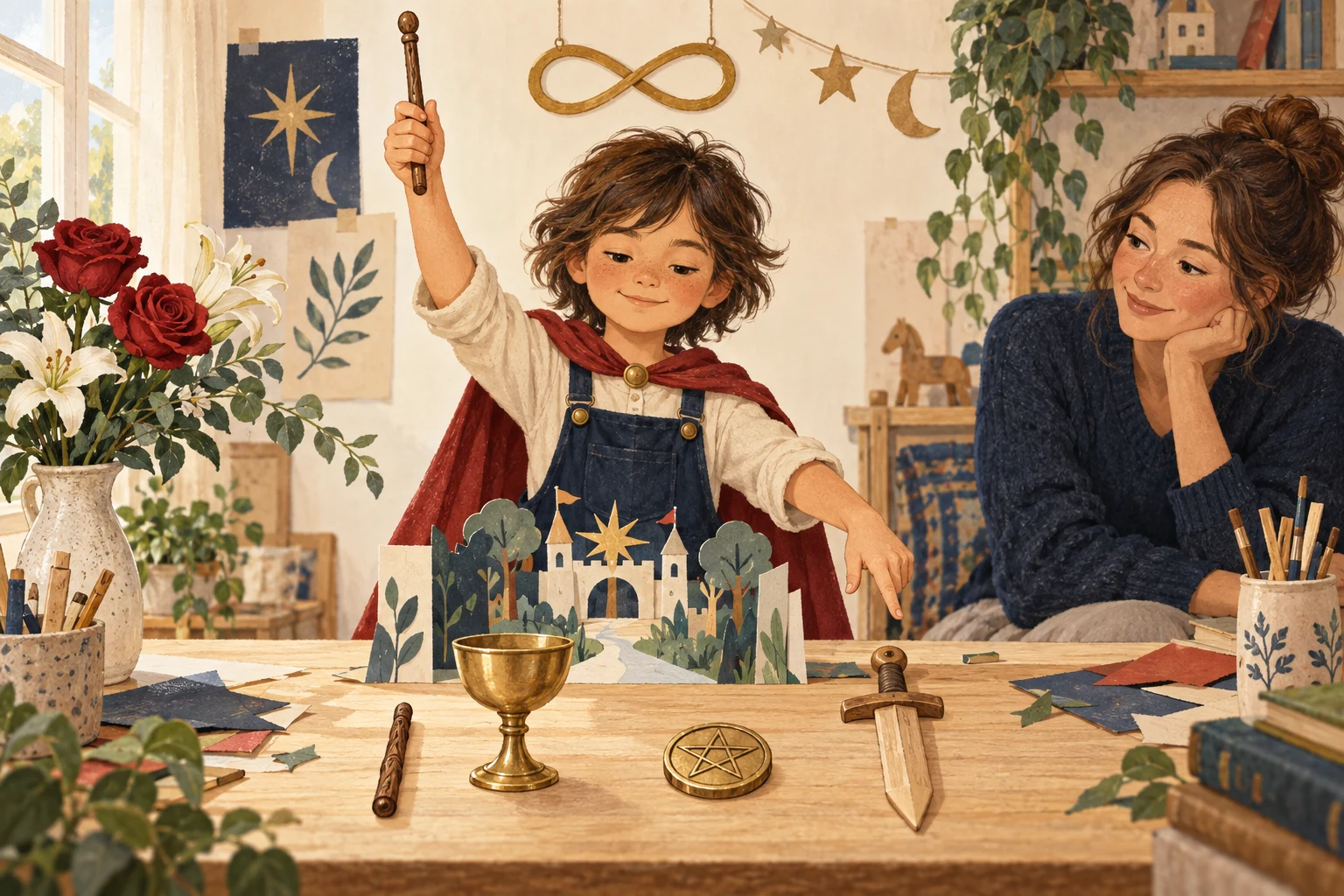
How can you help a child who wants to do everything themselves? When should you step in, and when should you let them try? And what can you say when a child who was happily building a moment ago pushes the pieces away: “I can't do it”?
In AstraFate's child chart, these questions connect with Arcana 1, the Magician: a symbol of curiosity, initiative, and original ideas. Its theme is familiar to parents. A child learns to imagine something, give it a go, and gradually work through difficulties. An adult helps them find a manageable task, cooperate with others, and decide what to do after a mistake.
The chart offers a symbolic perspective on your child. An arcana does not determine their character or future. Start with their age, interests, and what is actually happening in your family.
What does the Magician mean in a child's chart?
In AstraFate, the Magician is associated with the power of thought and words. In childhood, that image takes shape through simple actions: inventing a game, explaining its rules, gathering the players, and starting to play. An idea continues through action.
The Magician's strengths include curiosity, resourcefulness, independence, and the ability to get others interested. You can look for these in everyday activities. A child makes a garage from a cardboard box, asks why a ship floats, suggests changing a familiar game, or eagerly tells you about a discovery.
That interest need not fill the room. A child might quietly build their own model or write stories in a notebook. The Magician does not require them to be the loudest, most sociable, or first at everything.
A useful question for parents is: what already interests my child, and how can we make room for it in everyday life?
Helping your child become more independent
Before helping, look at the difficulty itself. Is your child asking you to demonstrate an unfamiliar step? Trying several approaches? Or already tired and ready to stop? The answer helps you decide what kind of support fits.
Imagine your child building a tower. You can see that the narrow base will not hold it. If the pieces are safe and there is time, you can wait and let them test their idea. If the tower falls, try: “Shall we see what we could change at the bottom?” It is an opportunity to work out together what happened.
Sometimes holding a piece or finding a material is enough. Before rebuilding the whole thing, ask: “How can I help?”
There are also mornings when you must leave in five minutes. You can say: “I'll help with the fastening today so we get there on time. You can have another go this evening.” Make sure that later opportunity really happens. Every task need not become an independence exercise.
Offering a choice while keeping a rule
Independence is easier to discuss when it is clear what the child can decide. You might have chosen the materials for a greeting card, while they choose the picture and colours. Or the building pieces need putting away, but they can choose which box to start with.
For children aged 2–4, the CDC recommends clear, age-appropriate instructions and two simple choices. For example: “Will you wear the grey trousers or the blue ones?” The choice sits within an action you have already explained. CDC: Tips for Giving Directions, 2026.
Offer options you can genuinely accept. If your child gets to choose the card's colours, let them choose a combination you would not pick. When a decision is already made, state it plainly: “It's time to leave. Please put your shoes on.”
Within the Magician's theme, this brings an idea together with clear conditions: what I can choose, what needs agreement, and where I will need help.
When your child wants to boss everyone around
In the Magician's childhood interpretation, wanting to organise a game can sometimes become a demand that everyone follow one's own rules. This is a possible situation to consider, not a description of every child with this arcana.
Suppose your child invents a shop game, assigns every role, and refuses to let anyone swap. You might say: “You came up with the shop. Now ask the others who they want to be.” Help them find a specific agreement: change roles after each customer, or let everyone contribute one idea.
The task becomes understandable: listen to the players and work out how to play together. “Stop bossing everyone around” may not tell them enough. Show them something they could say: “I'd like to be the shopkeeper first. Who wants a turn after me?”
These lines are examples to adapt to your child's age and the situation. They need not end an argument immediately. If the children cannot agree yet, suggest a break or another game.
When the first mistake brings “I don't want to”
Avoid jumping to laziness or the arcana as an explanation. First find out what happened. Did your child misunderstand the task, choose something too difficult, get tired, or lose interest? Sometimes they can explain; sometimes it is easier to ask them to show you the tricky part.
You could try this conversation:
— Show me where it went wrong.
— It keeps falling apart here.
— Would you like me to hold this part while you attach the other one?
The help addresses one particular difficulty. If your child wants to continue, there is still a part that belongs to them. If they are tired, put the activity aside and decide later whether they want to return to it.
The Magician's interpretation includes learning to take an idea through to a result. At home, choose a small, clear finish: build one toy car, complete one page, or prepare one dish together. If the idea was too big, discuss what you can realistically finish today. The arcana does not require a child to complete every project at any cost.
What to notice and say
Try naming something you actually saw:
- “You worked out how to attach the roof.”
- “You asked your sister which role she wanted.”
- “It didn't work at first, so you tried another way.”
These words show what caught your attention. In its guidance for parents of children aged 2–4, the CDC suggests describing a child's actions as one way to join in and show interest. CDC: Tips for Connecting and Communicating, 2026.
You need not comment on every detail. Sit nearby, listen to a story, or ask your child to show you how their invention works. A particularly useful moment in the Magician's theme is when the child explains their own idea: what they hoped to make and what happened.
Talents and activities to explore
The Magician's entry in the child knowledge base includes creativity, building, working with words, and activities that turn ideas into something tangible. You can begin at home with an interest your child already has.
| If your child enjoys… | You could offer… |
|---|---|
| Finding out how things work | Building sets, model making, age-appropriate coding |
| Imagining and making things by hand | Modelling clay, drawing, crafts, cooking together |
| Talking and inventing stories | An illustrated story, a family magazine, interviews with relatives |
Choose one thing to try. Afterwards, ask what they enjoyed, what was difficult, and whether they want to do it again. There is no need to buy a large kit or sign up for a whole year straight away.
The knowledge base also mentions music, dancing, swimming, gymnastics, and team activities. The arcana offers ideas for exploring different interests. The choice of a class depends on your child, their age, and the conditions there. Interests can change.
If you are already looking at the chart
AstraFate's child chart uses six points in the personality triangle. The Magician is read alongside the other arcana, and its position changes the question to consider.
At the top, attention turns to the child's main strengths. For the Magician, these are initiative, curiosity, and the wish to bring an idea to life.
At the two base points, the reading considers familiar ways of relying on one's abilities and responding to events. With the Magician, look at how your child offers solutions, asks for help, and tries to act independently.
At the inner points and the lower vertex, the focus is on abilities that are currently hard to express. For the Magician, consider what might help your child share an idea or attempt a small task themselves. The precise interpretation depends on the whole chart; one point cannot establish the cause of a difficulty.
Something to try today
Invite your child to choose one small activity they find interesting: make a card, build a toy house, or invent a short story. Agree on what you need and where they would like help.
During the activity, notice your own urge to step in. Does your child need a hint right now? Or would you simply like a quicker, tidier result? If everything is safe, you can wait a little and see what approach they choose.
At the end, ask: “What do you like about it?” They may show you a completely different detail from the one you thought was best. Start the conversation there: it is a chance to learn more about their idea.
Sources
The Magician's interpretation follows AstraFate's child knowledge base and the descriptions of positions in the child's triangle. This is an esoteric method. The everyday situations and conversations are illustrative examples written for this article.
Selected communication suggestions draw on CDC materials for parents of children aged 2–4. These materials do not study or validate arcana meanings:
- Tips for Giving Directions. Centers for Disease Control and Prevention, National Center for Injury Prevention and Control, April 30, 2026. Official publication.
- Tips for Connecting and Communicating. Centers for Disease Control and Prevention, National Center for Injury Prevention and Control, April 30, 2026. Official publication.