Spirituality & lineage · Arcana 13

Death — meaning of Tarot Arcana 13 in spirituality and lineage

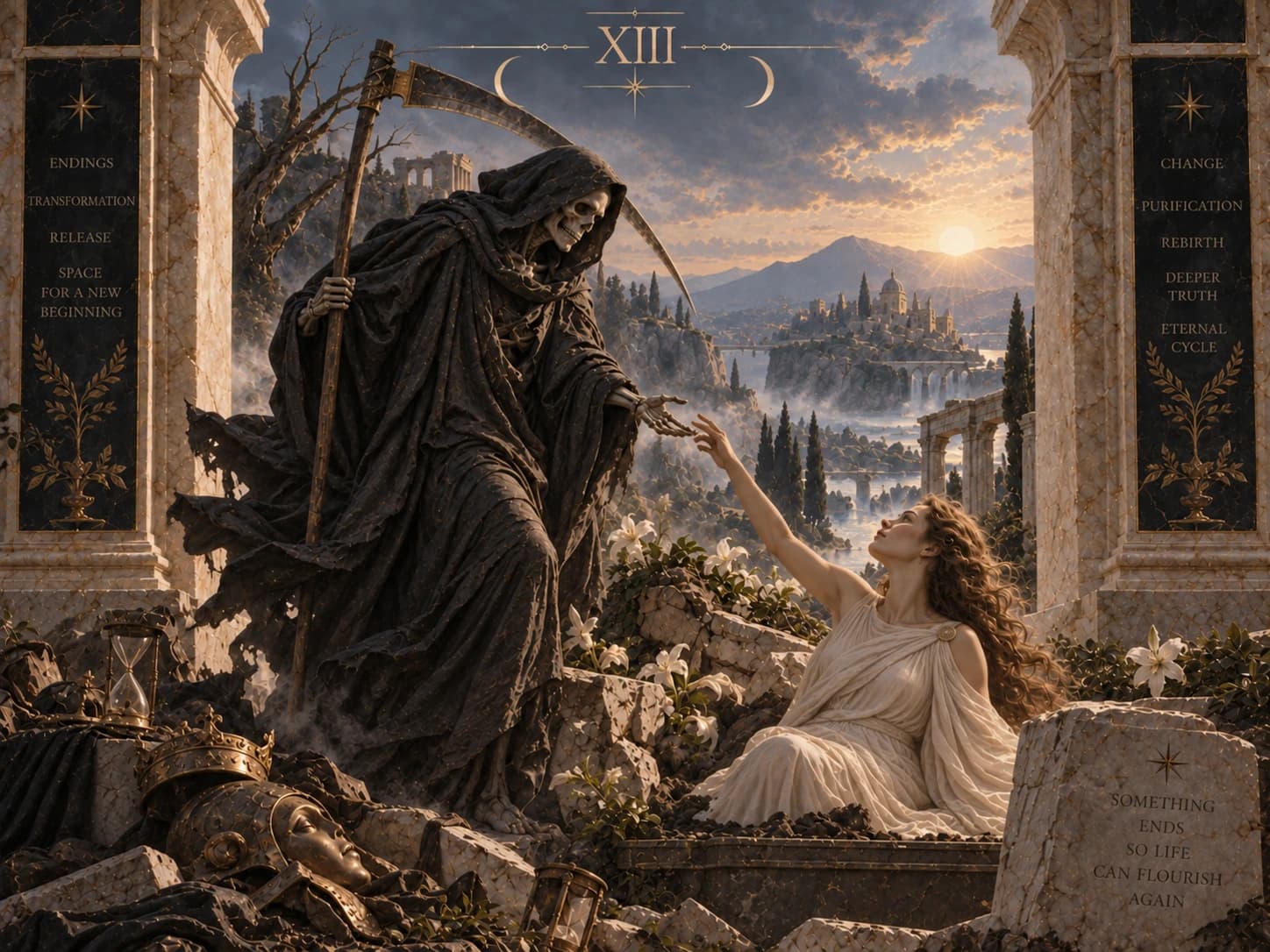
In Tarot, Death is not a prediction of literal death. It appears when an old form of life has ended even though a person is still trying to hold it in place. In spirituality and lineage, this card helps someone say goodbye to what should not be handed to children: silence, guilt, fear of change, or a role once adopted for survival.

Death — meaning of Tarot Arcana 13 in spirituality and lineage

Meaning of the Tarot card

An ending makes room

Arcana 13 is rarely comfortable, but it is honest. A new beginning cannot take shape while the old story is being protected from change. An ending can be quiet: stop defending yourself, call things by their real names, remove objects tied to pain, or allow yourself to live differently from your family. Respecting the past does not require repeating all of it.

This guide explains the Tarot card Death: the meaning of Arcana 13 in spirituality and lineage. Below is an interpretation of the Tarot card in different positions.

I release what has reached its end so life has room for what comes next.

What mature Arcana 13 does

Mature Death does not destroy for the sake of destruction. It helps a person acknowledge an ending, grieve it, and stop carrying the old form into the next stage.

  • They call an ending an ending instead of keeping a relationship or role alive out of fear.
  • They can release a family rule when it protects the past more than the people who are alive now.
  • They let grief and anger have their time without demanding to become a “new person” overnight.
  • They separate gratitude toward elders from an obligation to repeat their mistakes and limits.
  • After letting go, they build something concrete: a different conversation, rhythm, choice, or way of being close.

When an ending is postponed forever

Death's shadow keeps someone in an in-between life: the old no longer brings joy, but admitting its end feels frightening or disloyal.

  • They keep a broken relationship because their family never taught them to be the one who leaves first.
  • They are afraid to change a home or release objects because carrying someone else's pain feels like loyalty.
  • They cut off the past abruptly without understanding what they genuinely want to keep from it.
  • They expect loved ones to accept every change immediately and leave no time to adjust.
  • They return to the old pattern after every fresh start because the empty space between them feels unbearable.

In everyday life

Arcana 13 in three everyday situations

Death shows up when the useful move is not to repair the past, but to admit that its time is over.

01

Leaving is not a defeat

A person leaves a relationship that has been held together by fear and habit. They do not need to turn the other person into an enemy in order to draw a line. Over time, their voice, space, and ability to build a different life return.

02

A family secret stops travelling through silence

There is a subject everyone avoids so an old pain will not be disturbed. One person begins to speak about it carefully, without searching for someone to blame. Silence does not disappear in one conversation, but children no longer have to carry an adult secret for the family.

03

An object can be released without betrayal

After someone dies or leaves, a home stays unchanged for a long time. A person keeps a few things that truly hold memory and lets the rest go. Memory remains in relationships and actions, not only in cupboards.

Practice

Three questions about endings

Sometimes a new stage starts with a simple admission: this no longer works, and I do not want to pass it on.

  1. 1What has already ended in my life, but I keep maintaining out of guilt, fear, or habit?
  2. 2Which family pattern am I ready to stop with me, even if the first feeling is unfamiliar emptiness?
  3. 3What from the past do I want to keep as memory, and what only as experience rather than something to carry forward?

Choose one story that has ended and write three short phrases: “I am grateful for…”, “I am not taking… with me”, and “Now I will try…”. Do not force relief to arrive immediately. Release can feel like silence before it feels like freedom.

Position in the chart

How Arcana 13 changes across the spirituality and lineage triangle

Across the points, Death shows what in your story is asking to end: a habit, a role, a debt, or a way of keeping memory.

01Vertex

Second purpose and the ability to complete

At the vertex, Arcana 13 shows the second purpose connected with the birth month: learning to close cycles in time and helping others move through change without unnecessary destruction. After age 25, this may appear through crisis support, research, medicine, psychology, or projects that turn an old form into a new one. The aim is not to create upheaval for its own sake or cut every bond that becomes difficult.

02Two foundations

Lineage endings and room for the new

The left foundation is connected with the male line on the father's side, and the right foundation with the male line on the mother's side. Arcana 13 here may show which losses, breaks, and unfinished stories travelled through the generations. The task is not to blame the lineage or cling to its pain, but to complete what can now be completed and make room for another kind of life.

03Inner triangle

A past pattern around change

At an inner point, Arcana 13 shows fear of release, abrupt erasure, stuck grief, or a habit of holding pain as part of one's identity. The exact meaning depends on the point and neighbouring Arcana. Growth begins when a person acknowledges the loss, separates memory from an obligation to suffer, and takes the next step at their own pace.