Spirituality & lineage · Arcana 4

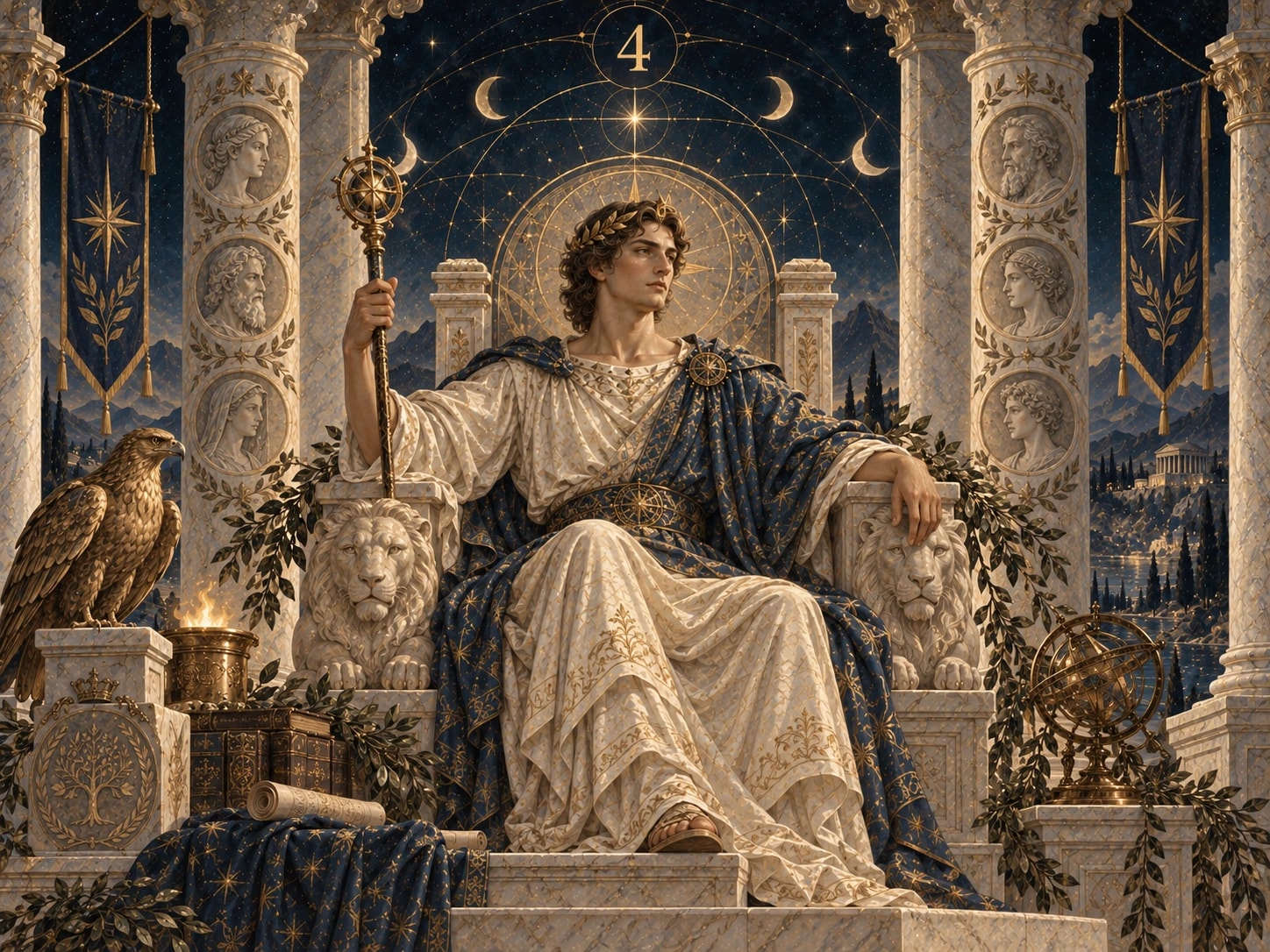
The Emperor — meaning of Tarot Arcana 4 in spirituality and lineage

In spirituality and lineage, the Emperor appears through responsibility, order, and the ability to create reliable support. This energy keeps its word, protects what matters, and turns beliefs into a steady way of acting. In shadow, order becomes rigid control and strength becomes a demand for obedience.

The Emperor — meaning of Tarot Arcana 4 in spirituality and lineage

Meaning of the Tarot card

Strength that gives life a shape

The Emperor reminds us that spiritual maturity is visible not only in ideas, but also in how a person handles power, duties, and boundaries. In a mature expression, Arcana 4 creates rules that help people feel safe and can revise them when life changes. In relation to lineage, it means taking responsibility for one's part of the story, preserving useful structure, and not carrying old harshness into new relationships.

This guide explains the Tarot card The Emperor: the meaning of Arcana 4 in spirituality and lineage. Below is an interpretation of the Tarot card in different positions.

Real strength does not need fear. It creates an order where people can grow and remain themselves.

What a mature Emperor looks like

A mature Emperor joins firmness with respect and uses strength to support rather than suppress.

  • They keep their word and take on a realistic share of responsibility instead of promising more than they can do.
  • They create clear rules and boundaries that protect people rather than punish disagreement.
  • They respect authority but test it through actions and do not hand their right to choose to one powerful person.
  • They can update an outdated system while preserving its purpose and considering the consequences of change.
  • They become a source of support in difficult moments without taking away other people's chance to cope and grow independently.

When support becomes rigidity

The Emperor's shadow appears when order is needed not for safety, but for control over people, feelings, and the future.

  • They demand obedience and present their own rules as the only correct or spiritually justified ones.
  • They confuse responsibility with having to decide everything for everyone and refuse to recognise other people's competence.
  • They preserve family customs simply because that is how things have always been, even when those customs cause harm.
  • They suppress vulnerability and see asking for help as weakness or unworthy behaviour.
  • They use fear, guilt, and punishment where a conversation, a boundary, and respect for choice are needed.

In everyday life

Arcana 4 in three everyday situations

The Emperor is especially visible in how a person sets rules, carries responsibility, and relates to family authority.

01

A rule protects instead of frightening

A family agrees on a simple rule: everyone says if they will be late and can explain a breach without being humiliated. The rule creates predictability without becoming a reason to punish. Order becomes a form of care.

02

Strength respects boundaries

A person is responsible for a shared project and is used to controlling everything. They divide the work, make decisions in their area, and let others complete their part in their own way. Reliability remains when control becomes cooperation.

03

Family authority leaves room for dialogue

An older relative says, “This is how we have always done it.” The person respects the experience but asks questions and decides which part of the rule is still needed today. Connection with the lineage survives when respect does not require blind obedience.

Practice

Three questions about inner support

These questions help distinguish mature responsibility from control that only looks like strength.

  1. 1Which of my boundaries genuinely protects life, and which one simply demands behaviour that is convenient for me?
  2. 2What family rule do I still follow even though I no longer understand its purpose?
  3. 3Where can I share responsibility and let another person act independently?

Choose one rule you often use in family life or at work. Write down what problem it solves, whom it protects, and how it could become gentler. Then discuss it with the people it affects.

Position in the chart

How Arcana 4 changes across the spirituality and lineage triangle

Arcana 4 keeps its theme of responsibility, order, and strength, but its task changes with the point of the second triangle where it appears.

01Vertex

Second purpose and mature support

At the vertex, Arcana 4 shows the second purpose connected with the birth month: building inner support, taking responsibility for decisions, and creating an order that helps life develop. After age 25, this may appear as a need to define personal rules and a relationship with authority. The aim is not to become a rigid keeper of order, but to create a form with room for change, dialogue, and freedom.

02Two foundations

Lineage patterns and the family model of strength

The left foundation is connected with the male line on the father's side, and the right foundation with the male line on the mother's side. Arcana 4 here may show an inherited power pattern: who makes decisions, who is allowed to be vulnerable, and how reliability is proved in the family. The task is not to blame the lineage, but to keep responsibility and protection while letting go of fear, suppression, and silent obligation.

03Inner triangle

A past pattern around power

At an inner point, Arcana 4 shows patterns of rigidity, control, suppressed vulnerability, or dependence on outside authority. The exact meaning depends on the point and neighbouring Arcana. Growth begins when a person can hold a boundary without threats, acknowledge mistakes, and build support that does not require other people to submit.