
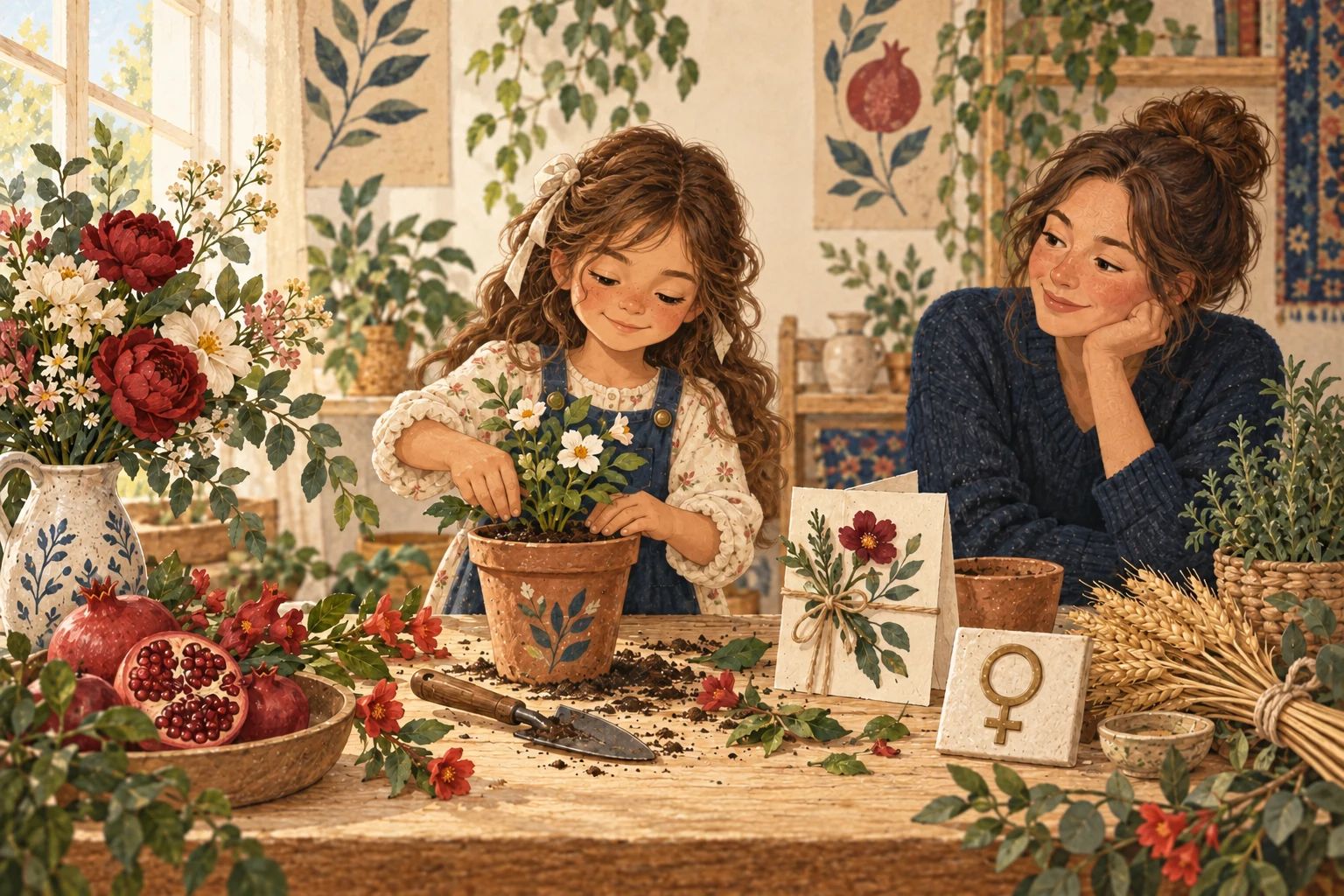
Care helps a child grow when it leaves room for their own choice.
Why does a child love decorating their room, making handmade gifts, or looking after plants? Why can they feel disappointed when the result is not as beautiful as they imagined?
In the AstraFate child chart, these patterns connect with Tarot Arcana 3, the Empress. Her theme is care, creativity, beauty, and the ability to create comfort around oneself. For parents, this is a way to support generosity and taste while protecting independence.
The chart is a symbolic way to observe, not a diagnosis or a fixed forecast. Look at the child's age, interests, and real actions rather than one Arcana on its own.
What Arcana 3 can mean for a child
The Empress notices what could become warmer, more beautiful, or more useful. A child may care for a younger sibling, feed a pet, water plants, bring friends together, or invent gifts for people they love.
The strengths of Arcana 3 include generosity, creative initiative, a sense of form, and the ability to see the result of their work. The child may want to decorate a card, bake cookies, or make a small exhibition, not only imagine an idea.
The Empress does not mean a child must be a quiet helper or love only crafts. Care can appear in conversation, organizing play, attention to animals, sport, cooking, or interest in how the surrounding space works.
Care without overprotection
Children benefit from seeing that care is shared responsibility. Give them a manageable task: fill a pet's bowl, put away art supplies, or choose napkins for the table.
Show a safe method first, then step back. If you redo the result every time, the child hears that their effort was not good enough.
Try: ‘I am here if you need help. Have a go, then show me.’ Adult care remains available while the child gains experience making decisions and completing a task.
Creativity and a visible result
The Empress likes to see an idea become an object, drawing, meal, or welcoming space. Choose small projects that can be finished in one evening or a few short sessions.
If a child chooses an unusual colour combination, ask what they wanted to express. A conversation about intention develops taste better than a model they must copy.
The result can be shared without turning attention into a competition. Specific feedback is more useful: ‘You found a way to hold the branches’, ‘You sorted the materials yourself’, ‘You noticed the vase needed support.’
Beauty, shopping, and comparison
In shadow, Arcana 3 can look like comparing oneself with friends by clothes, toys, or appearance. Envy does not make a child bad; it can show a wish to feel accepted and noticed.
Separate a wish from what is possible: ‘You like this set. What exactly draws you to it, and could we make something similar from what we already have?’ Interest remains, while the child learns to work with resources.
Talk about beauty as something varied, and about a person's value as separate from the price of an item. Set reasonable limits for clothing or room design and leave real choices inside them.
Generosity and personal boundaries
The Empress likes to share, but generosity does not mean giving away everything. Ask the child: ‘Do I want to give this, or am I afraid people will not love me otherwise?’
If they do not want to share a toy, a calm answer is enough: ‘It is yours and you can keep it. Let us choose what you truly want to share.’ The ability to say no protects care from resentment and exhaustion.
In group play, agree on rules in advance. A child can offer an idea and bring people together, while everyone still has a right to their own role, a pause, and a refusal of unsafe or unpleasant actions.
Empress talents: what to try
Possible strengths of Arcana 3 include drawing, decorative art, music, theatre, cooking, floristry, sewing, design, and projects that join usefulness with beauty.
Practical projects work well too: decorate a family celebration, grow herbs, make a gift, design packaging, or plan a small shared budget. The child should be able to shape the idea and see what came of it.
Choose a class as a trial. Interests may change, and the work does not need to meet adult standards. The aim is to experience creating, caring, and finishing a manageable task.
- Drawing, decorative art, and design
- Music, singing, theatre, and dance
- Cooking, floristry, sewing, and crafts
- Gardening, ecology, and caring for animals
- Project and entrepreneurship activities for children
Reading Arcana 3 in a child's chart
The Empress changes meaning with its position and the other numbers. One Arcana does not describe a child completely or establish the cause of behaviour.
At the vertex, Arcana 3 can point to a leading ability to create warmth, beauty, and a tangible result. At the base, it can describe a familiar way of showing love: helping, decorating, sharing, or bringing people together.
In an inner point, the Empress may show creative initiative that has not found an outlet or difficulty caring for oneself. Small independent tasks, clear limits, and permission to do things in one's own way help.
If Arcana 3 appears in the childhood-scenario layer, it points to a possible risk of pressure around success, appearance, or overprotection. It does not claim this happened. Adults can soften the risk by separating love from achievement and gradually sharing responsibility.
One thing to try today
Invite the child to choose one small task for a shared space: arrange flowers, decorate a shelf, prepare a simple snack, or make a card. Ask which part they want to do themselves.
Agree on two conditions: what must be safe and what needs finishing afterwards, such as washing brushes or cleaning soil from the table. Within those limits, let the child choose materials and method.
Afterwards ask: ‘What do you like about the result? What would you change next time?’ This supports taste and responsibility together.
Sources and limits
The Empress description is based on AstraFate's Arcana 3 child-matrix program and its position-reading rules. This is an esoteric method for observation and conversation, not a scientific assessment of a child's personality.
The qualities, talents, and activities are possible directions to try. They are not requirements, guarantees, or a replacement for professional support when a child needs it.
The heart of Arcana 3 for a child
The Empress reminds us that care, beauty, and creativity grow through everyday actions. A child needs not only to receive help, but gradually to choose what they want to create and what they can take responsibility for.
Support the idea, name specific effort, and leave manageable room for independence. Generosity then stays sustainable, and a love of beauty does not depend on other people's approval.